The Skincare Arrives in a Week. The Food Is Where It Gets Complicated.
You’ve been home about a month.
The tube is empty. The snack drawer is empty. The little bottle of sesame oil you wrapped in a sock and prayed over at baggage claim is empty. And it turns out the thing you actually miss isn’t the trip — it’s the groceries.
So you type Korean products online into a search bar and get a wall of names. Gmarket. YesStyle. Olive Young Global. H Mart. Some site you’ve never heard of, 40% off everything, checkout in three languages, reviews that all sound like they were written by the same person.
Most answers to this question are just a longer wall of names.
That’s the wrong variable.
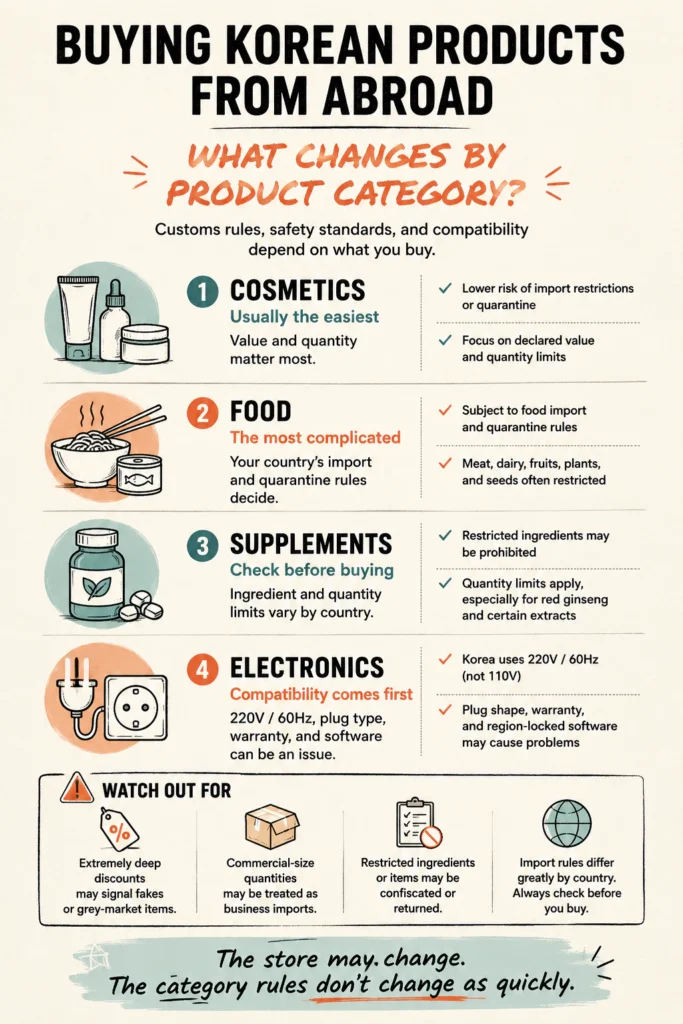
Whether your order arrives in nine days, arrives in nine weeks, or arrives as an email telling you to come explain yourself to a customs office has very little to do with which logo you clicked. It has almost everything to do with what you put in the cart. Cosmetics, food, health supplements, and electronics leave Korea in the same kind of box and hit four completely different walls at the other end.
So here’s the map by category — and the places where the site name genuinely does matter.
Where can I find Korean products online?
There are three shapes of seller, and they aren’t really competing with each other. They serve different situations.
International K-retailers. YesStyle, Jolse, Stylevana, KollectionK, Wishtrend, Soko Glam, RoseRoseShop and the rest of that tier. English checkout, international shipping built into the business, prices already converted, customer service that expects to hear from someone outside Korea. The trade-off is curation: they carry what sells abroad, which is a narrower shelf than the one you were standing in front of in Seoul.
Brand and store global shops. Olive Young Global, and the global stores individual brands run themselves. This is the closest thing to buying from the actual shelf you were standing in front of in Seoul, and it’s the cleanest answer to the authenticity worry, because there’s no third party between you and the brand. Assortment and shipping destinations vary more than people expect.
Korean domestic marketplaces with a global door. Gmarket and 11st both run English-facing versions. This is where the catalogue gets wide — food, kitchen things, household items, the small unglamorous stuff nobody exports on purpose. Two caveats worth knowing before you get attached: the global storefront is a subset of the domestic one, not a translation of it, and Korean domestic services in general tend to ask for an identity verification a foreign phone number can’t clear, which is a wall a lot of visitors have already met. Coupang, the one your Korean friends use for everything, is essentially a domestic service.
If what you’re re-buying is skincare specifically, that’s a well-worn path with its own set of trusted names and traps — we mapped it in re-buying Korean skincare from abroad.
For everything else, the seller is the easy half of the decision.
The four categories that behave completely differently
Cosmetics. The easy category, and the reason so many people assume ordering from Korea is simple. Sealed, shelf-stable, no quarantine interest, no plug. Only two numbers really apply: the declared value against your country’s personal-import allowance, and the quantity against what your customs office considers a plausible amount for one household. Ten sheet masks is a haul. Two hundred is a business, and it gets treated like one — which is the trap people hit most often.
Food. The hard category, and the important thing is that it’s hard at your end, not Korea’s. What decides it is your country’s quarantine and food-import rules, which differ enough that no single answer covers everyone. The recurring interception across most systems is meat: dried meat, meat-based soup bases, and the seasoning sachets inside some instant noodles. Anything fresh, homemade, or unlabelled sits in a stricter lane than anything sealed and commercially packaged with a printed ingredient list. Sealed, labelled, meat-free is the boring end of the spectrum, and boring is what you want here.
Health supplements. The middle category. Sealed and commercial helps, but supplements attract quantity limits and ingredient rules that plain groceries don’t. Red ginseng products are the reassuring exception in practice: the major Korean brands run their own overseas retail, so the sealed branded version is usually obtainable locally without an import question at all.
Electronics and appliances. The physics category. Korea runs on 220V at 60Hz with the round two-pin plug — which means a Korean appliance is a genuine electrical decision, not a plug adapter decision, and heating appliances in particular are the ones a travel transformer handles worst. Then the software: Korean-language interfaces and firmware that expects a Korean network, warranties that are domestic-only, and service that assumes you can walk into a branch in Seoul.
A rice cooker isn’t a souvenir. It’s an appliance import, and it should be argued with on those terms.
I want to buy Korean beauty products, are there any sites like aliexpress?
Structurally, yes — Gmarket and 11st are marketplaces in exactly that sense, and there’s no shortage of general global marketplaces listing Korean brands.
But the marketplace format changes something people don’t always register: it changes who you are buying from.
On a retailer, you buy from the store. One inventory, one reputation, one entity that has to answer for what shows up. On a marketplace, you buy from a seller who rents a storefront inside a platform you trust. The platform’s name is on the checkout page. The platform’s name is not on the box.
That seller layer is where the complaints live. It’s the specific thing behind a question that keeps coming up in near-identical form: “I do not trust AliExpress where a lot of Korean cosmetics listed are actually fake.” That’s not a superstition. Deep-discounted listings of famous Korean skincare on general marketplaces are the most frequently reported route to a counterfeit, and the mechanism is boring — nobody upstream is checking, and the price is doing the lying.
The practical split most people land on: marketplaces are excellent for the unglamorous, low-stakes half of the cart — snacks, kitchen tools, household things, stationery, the stuff nobody bothers to counterfeit. For high-value branded skincare, the seller layer is exactly the thing you’re paying a retailer to remove.
Is there any place in France where you can buy Japanese/Korean cosmetics?
Almost certainly, and the answer generalizes to most large cities.
Three local channels tend to exist:
- Korean and Asian grocery stores. In cities with an established Korean community, these carry a beauty shelf alongside the food, and Paris has had a Korean cluster for a long time. The beauty selection is small and the food selection is the real reason to go.
- Mainstream beauty retail. Big chains in Europe and North America have been steadily adding a handful of Korean brands. Narrow, expensive, but sitting there in a shop you can walk into today.
- Regional K-beauty specialists. Local importers and boutiques, often online, sometimes with a physical shop. They ship domestically, which removes the customs question entirely.
The trade-off with all three is the same: the assortment was chosen for you, and you’ll pay the import margin. What you get back is speed and no paperwork.
There’s one more wrinkle worth knowing, and it explains a complaint people make constantly without understanding it: for food especially, the version on the shelf abroad often isn’t the version you ate in Korea. Export lines exist. People who cook Korean food outside Korea describe the widely distributed gochujang, soy sauce, and sesame oil as sweeter and flatter than the domestic versions — so you buy the little red tub with the familiar logo, taste it, and conclude your memory was exaggerating.
Your memory was probably fine. The product changed.
If that gap matters to you, the split is straightforward: mainstream staples are easy to find locally and may be the export formulation, while traditional or regional versions mostly aren’t distributed abroad at all — and finding those means ordering rather than shopping.
Where can I find authentic Korean cosmetics dropshippers based in Korea?
This one arrives dressed as a shopping question, but it isn’t one. Somebody asking for a Korea-based dropshipper is planning to sell.
The instinct behind it is sound: go upstream, and the authenticity problem is supposed to solve itself. The catch is that “based in Korea” isn’t the thing that guarantees anything. A dropshipper in Seoul is a middleman in the same sense as one anywhere else.
What actually settles the question is paperwork, in roughly this order:
- The brand’s own export or distributor programme. Some Korean brands run these directly and will tell you who their authorized distributor is for your market. That single answer replaces most of the searching.
- Authorized distributors. The layer that exists specifically so retailers abroad can buy without flying to Korea.
- Korean B2B sourcing platforms and export agents. Useful for breadth, variable in quality, and worth treating as a starting list rather than a verdict.
The thing to be blunt about: most “verified Korean dropshipper” directories you’ll find are themselves marketing, written by the companies inside them. Authenticity upstream is a documents problem — business registration, brand authorization, invoices that trace back to the brand — not a website problem. If a supplier can’t produce the paper trail, the fact that they’re in Korea buys you nothing.
Where can I find a Korean food wholesale supplier?
Two very different people ask this, and they need opposite answers.
If you just want a lot of one thing — a case of ramyeon, a box of the seaweed snacks your kids inhaled — that isn’t wholesale. That’s a bulk retail order, and the constraint isn’t finding a supplier, it’s that a large single-item shipment is exactly the shape that makes a customs office reclassify a parcel as commercial. Your local Korean grocer, who already imports legally and pays the duty, is usually cheaper than solving that problem yourself.
If you’re stocking a shop or a restaurant, the route is the importer layer, and there’s good news: it already exists. Every country with Korean grocery stores has at least one established Korean food importer supplying them — that importer, not a manufacturer in Korea, is your realistic first call. Working backwards from the shops in your city gets you there faster than any search.
Beyond that, there are public channels built for exactly this. KOTRA runs Korean trade offices in most major markets whose job is matching overseas buyers with Korean suppliers, and Korea’s agri-food export agency covers the food side specifically, including buyer matching and trade fairs. Neither is glamorous. Both are free, and both exist because the Korean side wants this to happen.
And one thing that surprises people who start here from the consumer side: importing food commercially puts you inside your own country’s import licensing, labelling, and food-safety system. The supplier is the easy half.
How far a list like this actually goes
Names of websites are the most perishable information in this entire piece.
Shops merge, get bought, block regions, suspend shipping lanes, or quietly stop serving your country while their homepage says otherwise. Any list of sites — this one included — is a snapshot of a moving thing, and the ones you find on other pages are frequently older than they look.
What holds up is the structure: seller type, category, and the two facts that decide your specific order.
- Does this seller actually ship to my country right now, as shown on their own shipping page?
- Is what I’m buying admissible where I live, in the quantity I’m buying it?
Those two are worth checking directly every time, because they’re the ones that change. Everything else in this piece is scaffolding for asking them.
And there’s one thing no list can tell you: whether the version being sold abroad is the version you fell for. That one you find out at the first spoonful.
The cart isn’t the decision. The category is.
The reason “where can I find Korean products online” has no clean answer is that it isn’t one question. Skincare is a shopping question. Food is a customs question. Supplements are a quantity question. Appliances are an electricity question. They just happen to share a checkout page.
Sort your list into those four piles before you shop, and most of the confusion resolves itself. The skincare goes to a retailer or a brand shop. The food splits into what’s easy to get locally and what genuinely has to come from Korea. The supplements you check once. The appliance you probably talk yourself out of, which is its own kind of savings.
So the question worth asking before you fill a cart isn’t which site is best.
It’s: which of these things do I actually want again — and which one am I ordering because it reminds me of being there?
FAQ
Can I order Korean food online and have it shipped to another country?
Often yes, but food is decided by the destination country’s quarantine and food-import rules rather than by the Korean seller. Sealed, commercially packaged, clearly labelled items sit at the easy end; meat-containing products such as dried meat and some instant-noodle seasoning sachets are the most commonly intercepted, and fresh or homemade items are treated more strictly. Because the rules differ substantially by country, the reliable step is checking your own customs or agriculture agency’s list for the specific item before ordering rather than assuming a general answer applies.
Why does Korean food from my local supermarket taste different from what I ate in Korea?
Many Korean staples are produced in separate export lines, and people who cook Korean food abroad frequently describe the widely distributed versions of gochujang, soy sauce, and sesame oil as sweeter and flatter than the domestic ones. Traditional or regional versions are generally not distributed to overseas supermarkets at all. If the difference matters, ordering the domestic version online is usually the only route, since local availability is limited to whatever the importer chose to carry.
Can I use Korean shopping sites like Coupang or Gmarket from outside Korea?
Gmarket and 11st run English-facing global storefronts that ship internationally, though those storefronts carry a subset of the domestic catalogue. Coupang and most other Korean domestic services are built for residents. The recurring obstacle is identity verification: Korean sites and payment systems commonly require a verification step tied to a Korean phone number or residency status, which a foreign phone number cannot complete.