You’re in a Korean Restaurant. The Chopsticks Are in a Drawer.
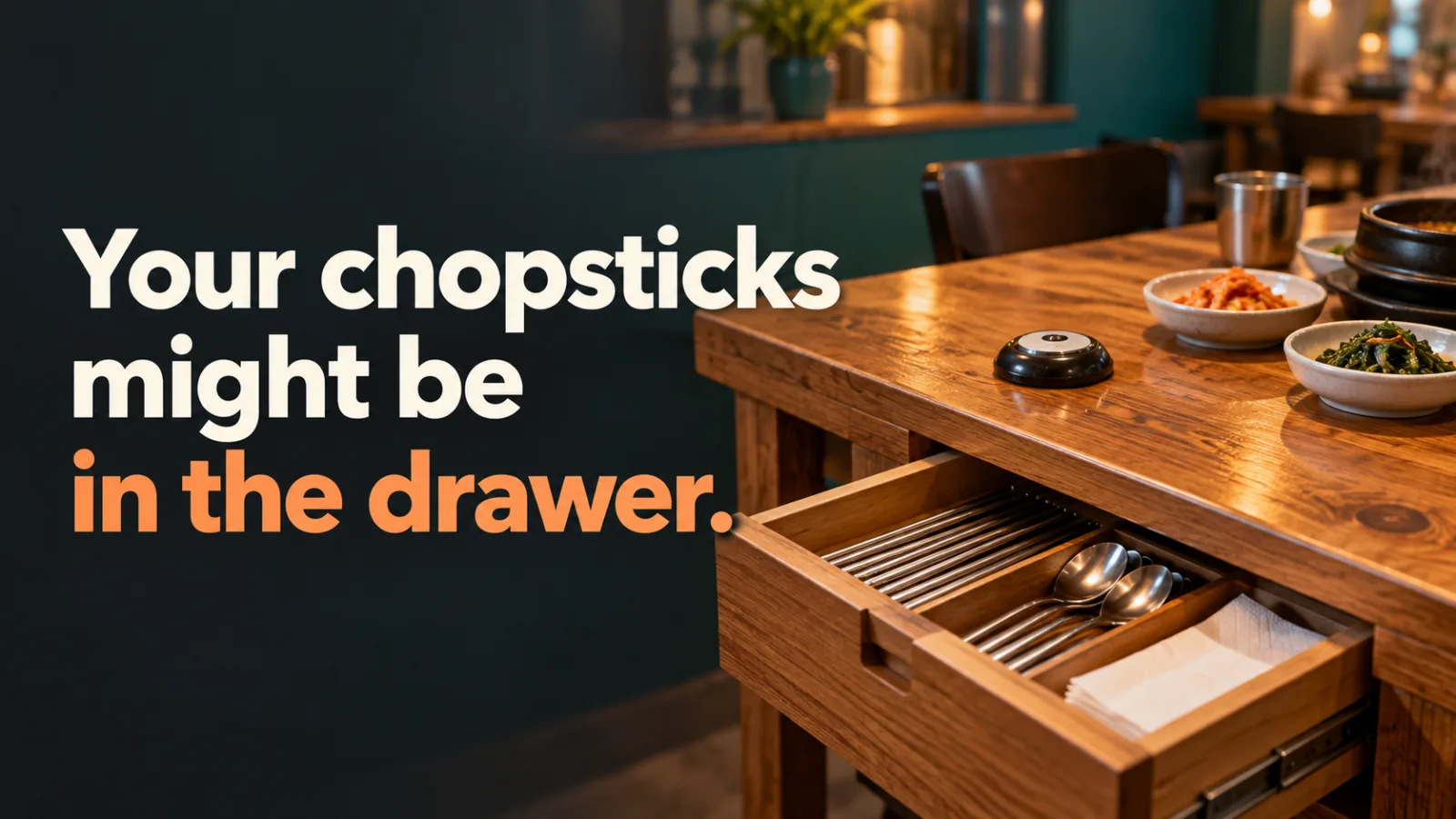
You’ve made it inside. Someone has shown you a table. The food at the next one looks exactly like what you came for.
So far, excellent.
Then you notice you have no chopsticks. No spoon, either. There’s a button beside the menu, but pressing it feels a bit like summoning someone, which seems rude. You wait politely.
The person at the next table opens a drawer, takes out chopsticks, and presses their button.
Ah.
A first meal in Korea can come with a few small discoveries like that. Once you know where to look and what to ask, you can spend much more of lunch thinking about lunch.
Going to Korea soon! What’s the annoying stuff about traveling there that nobody talks about?
At a casual restaurant, a lot of the confusion starts with things that are right beside you.
Check the table before waiting for utensils. Look for a drawer under its edge or a container on top. If there’s nothing obvious, ask. You’re looking for chopsticks, not solving an escape room.
If there’s a call bell, it’s there to be used. Press it once when you’re ready and give staff a moment. Without one, a polite 저기요 — jeogiyo, “excuse me” — can get someone’s attention.
Look for a self-service area. Water, cups, or basic side dishes may be there. 셀프 means self-service. If you can’t tell what you’re meant to take, ask before helping yourself.
The Korea Tourism Organization’s restaurant introduction explains these features. You’ll encounter different combinations of them; an individual restaurant may have none of the above.
Ordering can be pleasantly simple
Pointing to a menu item and saying 이거 하나 주세요 — “One of this, please” — is useful when you want one order. For a shared dish, confirm what an order means before you choose the quantity.
Take a moment with words such as 1인분 (one serving), 2인분 이상 (at least two servings), and 추가 (an extra or add-on). A photograph shows the food. The small print tells you what you’re ordering.
If you’re using a table screen, check the basket before confirming. It’s much easier to remove the accidental second rice now than explain it when both bowls arrive.
Is eating out alone in South Korea really that bad?
You can have a lovely meal by yourself. The useful question is what this restaurant will serve to one diner.
Travelers in this solo-dining discussion describe both easy meals and shared dishes with minimum orders. Those are experiences at particular places, so don’t turn either one into a rule for every restaurant in Korea.
Before settling in, ask:
혼자 식사할 수 있나요? — “Can I dine here alone?”
Then point to what you want:
이 메뉴는 1인분 주문 가능한가요? — “Can I order one serving of this dish?”
Those are two separate questions. Being offered a table doesn’t necessarily mean every shared pot or grill dish is available in a single portion.
If the menu says 2인분 이상, that item has a minimum of two servings. Ask what else you can order, or whether buying the minimum works for a solo guest. Let staff confirm it; ordering more food isn’t an automatic promise of a table.
For an easy first lunch, look for a menu with individual bowls or clearly described single-person meals. You can save the more complicated shared feast for another day, or find a place that explicitly offers it for one.
You don’t need to apologize for being hungry on your own.
A little more of that, please
반찬 — banchan — are the small side dishes that accompany many Korean meals. Basic refills are often included, but a separately priced dish or extra portion on the menu is a different order. Ask if you’re unsure.
Try 이 반찬 조금 더 주실 수 있나요? — “Could I have a little more of this side dish?” If there’s a self-service station, staff can point you toward it.
Take a little, then go back if you want more. It leaves space on the table for the food you actually ordered.
Do restaurants in Korea allow you to take away your leftovers?
Ask the restaurant about the food in front of you. There isn’t one answer that covers every dish, container, and kitchen.
남은 음식 포장 가능한가요? — “Could I take the leftover food to go?”
Point to the main dish you mean. Let staff say what they can pack; don’t assume that all the little side dishes come along too. If they can’t do it, leave it there. The question was perfectly reasonable.
The distinction is especially useful when you’re weighing up a two-serving minimum. Ask about leftovers before ordering if taking some home is part of your plan.
When you’re ready to leave
If you haven’t paid yet and aren’t sure where to do it, 어디서 계산하면 되나요? means “Where should I pay?” Follow the restaurant’s arrangement rather than waiting indefinitely for a bill to appear.
And if you’re mentally calculating a tip, you can read AAK’s guide to tipping in Korea. For an ordinary restaurant meal, a thank-you and the amount on the bill are the usual finish.
Next time, you’ll spot the drawer before sitting down. That’s a very small travel skill. It feels surprisingly good.
FAQ
Q: Going to Korea soon! What’s the annoying stuff about traveling there that nobody talks about?
At casual restaurants, check for a utensil drawer, a call bell, and a self-service water or side-dish area. These features vary by restaurant. Ask staff if you cannot find what you need.
Q: Is eating out alone in South Korea really that bad?
Solo dining is possible, but ask whether the restaurant seats one diner and whether your chosen dish can be ordered as one serving. Some shared dishes have minimum orders; that is not a rule for every Korean restaurant.
Q: Do restaurants in Korea allow you to take away your leftovers?
Ask staff about your particular dish. Packaging depends on the restaurant and food, and side dishes should not automatically be included. If taking leftovers home matters to your order, ask beforehand.