The Suitcase Won’t Close. Here’s How to Mail the Rest of Korea Home.
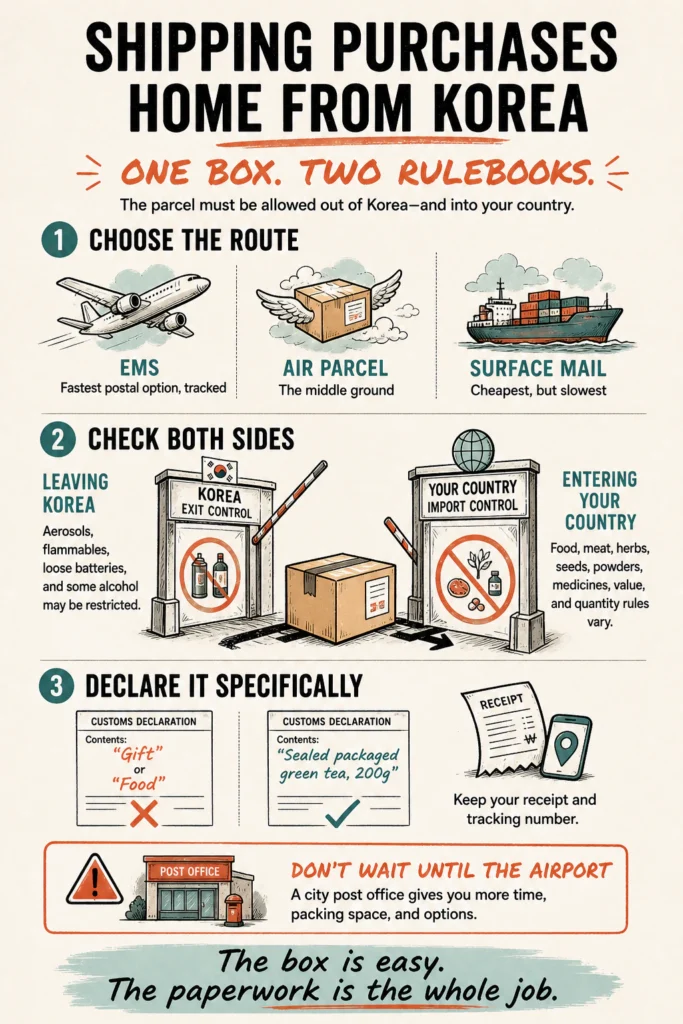
It usually happens on the floor of a hotel room, two nights before the flight.
You’ve got the suitcase open, and the arithmetic isn’t working. There’s a box of gifts for people at home. There’s the snack haul, which somehow doubled. There’s the skincare, which was supposed to be “a few things.” And there’s the sweater you bought because Seoul was colder than the forecast said.
You do the thing everyone does. You kneel on the lid. It still doesn’t close.
So you start googling, and the answers you find are a mess of forum threads from 2011, airline excess-baggage fees that make your eyes water, and a vague sense that the Korean post office is cheap — but you don’t know how cheap, what you’re allowed to send, or whether your box will ever actually arrive.
Here’s the reassuring part: this is one of the most well-trodden problems in Korean travel. The post office does this all day. The awkward part is that shipping from Korea is governed by two rulebooks at once — Korea’s, and your own country’s — and almost every horror story you’ll read comes from someone who only checked the first one.
shipping purchases from seoul to usa
This is the question in its purest form, and the answer splits cleanly into two paths: fast and tracked, or slow and cheap.
The main options people use:
- Korea Post (우체국) — EMS. The express international service. Tracked end to end, typically the fastest postal option, and the one most travelers default to. Post office branches are everywhere in Seoul, including in neighborhoods you’re already shopping in.
- Korea Post — air parcel. A step down from EMS in speed and price. Still airmail, still trackable in most cases.
- Korea Post — surface mail (sea parcel). The bargain floor. Your box goes on a ship. People routinely describe it as a fraction of the airmail cost, and the tradeoff is time measured in months, not days — commonly cited as up to around three.
- Private couriers — DHL, FedEx, UPS. Usually the most expensive, usually the most reliable for door-to-door tracking and customs handling. Worth it for something valuable or urgent, hard to justify for a box of snacks.
A few practical notes that come up again and again in traveler threads:
Post offices sell the boxes. You don’t need to arrive with your parcel already packed — branches stock standard shipping boxes in several sizes, along with tape, and there’s a counter where you fill out the customs declaration form. Bring your passport.
Weight is the price lever, not volume, up to a point. Postal services cap parcels somewhere in the 20–30 kg range depending on destination and service, so a genuinely huge haul may need to become two boxes.
And this is important: we’re not quoting prices here on purpose. The numbers floating around old forum posts — including the ones people swear by — are years out of date, and postal rates get revised. Check the current international rate table on the Korea Post site for your destination and weight before you plan around a number. What’s stable is the ratio: sea mail is dramatically cheaper than air, and air is dramatically cheaper than the airline’s excess baggage counter.
That last comparison is the one worth running first. If you’re over your baggage allowance, price the excess-bag fee against an EMS box. For a lot of people, mailing it is cheaper than flying it — and you don’t have to drag it through two airports.
Shipping luggage from Incheon Int’l Airport?
This is the same problem asked at a completely different hour: departure day, already at the airport, suitcase already over.
Your options narrow, and they get more expensive.
The airport does have postal and courier service points — Incheon has post office and parcel service counters, and airlines have their own excess-baggage and cargo desks. What changes at the airport isn’t availability, it’s leverage: you’re paying whatever’s in front of you, at whatever time it’s open, with a boarding time on the clock.
So the honest advice is: decide the night before, not at the check-in counter. A city post office branch during business hours gives you options, packing space, and time to fill out forms properly. The airport gives you one shot.
If you are already at the airport, a couple of things to know:
- Terminal locations and opening hours for airport postal and courier counters change, and the two terminals are not identical. Check the official Incheon Airport site for the current counter list and hours before you build a plan around it — especially for early-morning or late-night flights.
- Airline excess baggage is priced per bag or per kilo depending on the carrier and route, and it’s almost always cheaper if you pre-pay online rather than at the desk. If mailing has become impossible, that’s usually the next-best move.
One trap specific to departure day: the tax refund. If you’re planning to claim VAT back on your shopping at the airport, that process generally assumes the goods are leaving the country with you and can be presented if customs asks. Mailing those same items home the day before can complicate or void that claim. If a refund is part of your math, ask at the refund desk — or at the store when you buy — before you post the box.
Korean food/sweets to bring home?
The single most common category people try to mail, and the one with the most asterisks.
What travelers most often want to send home is exactly what you’d guess: the convenience-store snack aisle, gim (seasoned laver), instant ramyeon, honey butter chips and their descendants, traditional sweets, tea, red ginseng products, instant coffee sticks, gochujang and sauces.
Sealed, commercially packaged, shelf-stable food is generally the easiest category to move — and also the category most likely to be opened, inspected, or refused at the far end. The reason is that food doesn’t go through customs, exactly. It goes through quarantine, and quarantine rules belong entirely to your destination country.
The rough hierarchy people run into:
- Usually fine: factory-sealed dry snacks, packaged tea, candy, instant coffee, sealed sauces (though liquids add weight fast).
- Frequently a problem: anything containing meat — including the little seasoning packets in some instant noodles. Meat and meat-derived products are broadly restricted across many countries’ import rules, and a single flavor sachet can be the reason a parcel gets held.
- Depends heavily on where you live: seeds, fresh or dried produce, herbal and medicinal preparations, ginseng products. Countries with strict biosecurity regimes — Australia and New Zealand are the usual examples — treat these categories far more aggressively than most.
The practical rule that survives all of this: check your own country’s quarantine and import rules for food before you pack the box, not after. Your national customs or agriculture agency publishes the list. It takes ten minutes and it’s the difference between a gift arriving and a gift being destroyed.
If you’re still deciding what is even worth the shipping cost, our Olive Young sale guide is a useful sanity check on the shopping side — a lot of what ends up in the box was a sale-day impulse rather than something you’ll actually miss.
posting items – eg: teabags, herbs, toothpaste and flour
This one deserves its own section because it’s the question asked correctly. The person listing specific items is already thinking about the right thing: not “can I mail a box,” but “can I mail this.“
There are two separate lists, and you need both.
List one: what Korea won’t let out of the mail stream. Postal networks worldwide restrict the same broad categories, and Korea Post is no exception. The recurring offenders in a traveler’s shopping bag:
- aerosols and pressurized cans (some sunscreen sprays, hair products, dry shampoo)
- flammable liquids — nail polish, nail polish remover, high-alcohol-content products
- lighters, matches
- loose lithium batteries and some battery-containing devices
- alcohol, which is allowed to some destinations under specific conditions and prohibited to others
List two: what your country won’t let in. This is the list people forget. Food, plant material, seeds, herbal preparations, and anything medicinal live here. So do value thresholds, which we’ll get to below.
Applying both lists to the actual items in the question:
- Teabags — generally straightforward if commercially sealed, but they’re plant material, so a strict-biosecurity destination may want them declared. Herbal or medicinal teas are treated more cautiously than plain black or green tea.
- Herbs — the riskiest item on the list. Dried culinary herbs and anything that reads as medicinal or plant-propagative material are exactly what quarantine agencies exist to intercept.
- Toothpaste — normally unremarkable by post. It’s a sealed personal-care product, not a liquid restriction problem the way it is in your carry-on.
- Flour and powders — powdered goods (flour, powdered soup base, protein powders, some traditional food powders) attract extra scrutiny in international mail and screening, and some destinations restrict them outright. Declare them precisely by name.
The thread running through all of it: declare honestly and specifically on the customs form. “Gift” or “food” is the answer that gets a parcel opened. “Sealed packaged green tea, 200g” is the answer that gets it through. Vagueness reads as evasion, and inspectors respond accordingly.
Package stuck in Seoul
You mailed it, you got a tracking number, and now the tracking hasn’t moved in eleven days. It still says something with “Seoul” in it. Panic sets in.
Most of the time, this is not what it looks like.
Outbound international mail from Korea funnels through a central international mail center near Incheon before it leaves the country. A parcel showing a Seoul-area scan and then nothing usually means one of a few ordinary things:
- It’s on a ship. Surface mail has almost no intermediate scans by design. Weeks of tracking silence is the normal state of sea parcels, not a malfunction.
- It’s between networks. Tracking usually goes quiet in the handoff between Korea Post and the destination country’s postal carrier. The next scan often appears only when your local carrier picks it up — which can be a long gap depending on the country.
- It’s sitting in customs at your end, not Korea’s. This is the big one, and it’s the case people misread most often, because the last scan they can see is Korean.
That last scenario is where the real risk lives, and it has a specific shape. Here’s a case from a shopper who ordered around 23 products from Olive Young in a single shipment: their customs office threatened to destroy or return the package, on the grounds that a bulk order like that looked like a commercial import rather than personal use. They had already paid VAT. It didn’t matter — the tax wasn’t the issue; the classification was.
That shopper was ordering online rather than mailing a box to themselves, and the buying side has its own map — which sites are worth trusting, and how to size an order so customs waves it through. We laid it out in re-buying Korean skincare from abroad.
The same logic applies to a parcel you mail to yourself. Once it crosses your border, it’s an import, and two numbers decide its fate: the declared value against your country’s personal-import (de minimis) threshold, and the quantity against whatever your customs office considers plausible for personal use. Ten of the same sheet mask is a haul. A hundred is a business.
So if a parcel genuinely goes quiet past the normal window:
- Check the tracking number on your destination country’s postal site as well as Korea Post’s. The two systems show different halves of the journey.
- Look for a customs notice — held parcels usually generate one, and it can arrive by post or email and be easy to miss.
- Keep your receipts and the customs form copy. If you have to prove the contents are personal purchases at their declared value, that paperwork is the whole argument.
- Contact the sending post office if it’s genuinely lost. Inquiries typically have to start on the sending side, which is awkward once you’re home — one more reason to keep the receipt.
And if you’re wondering why you can’t just track it through a slick Korean delivery app the way locals do: that’s a real wall, not you. Most Korean apps require an identity verification visitors can’t clear, which we mapped in Korea’s invisible verification wall.
The box is the easy part. The paperwork is the whole job.
Shipping things home from Korea is genuinely cheap and genuinely routine. Nearly every problem people hit traces back to the same three places: they didn’t check the destination country’s rules, they were vague on the customs form, or they sent one enormous parcel when two modest ones would have sailed through.
Pick the service by how much your time is worth — EMS if you want it soon, sea mail if you’d rather have the money. Check your own country’s food and quarantine rules before you pack. Write exactly what’s in the box. Keep the value under your personal allowance if you can, and split the order if you can’t.
Do that, and the suitcase problem stops being a crisis and becomes a line item.
The question worth sitting with while you’re kneeling on that lid isn’t “how do I get all of this home?” It’s: which of these things did I buy because I’ll actually use them — and which did I buy because I was in Korea?
FAQ
Q: What’s the cheapest way to ship purchases home from Korea?
Surface mail (sea parcel) through Korea Post is generally the cheapest option, at the cost of transit time that is commonly described as up to around three months. Air parcel and EMS cost more and arrive far faster, with EMS being the tracked express service most travelers use. Private couriers like DHL, FedEx and UPS are usually the most expensive. Rates change, so check the current Korea Post international rate table for your destination and weight rather than relying on figures quoted in older forum posts. For anyone over their airline baggage allowance, it is worth comparing an EMS box against the excess-baggage fee — mailing is often cheaper.
Q: Can I mail Korean food and snacks home?
Sealed, commercially packaged, shelf-stable food is generally the easiest category to send, but food is judged by your destination country’s quarantine rules, not Korea’s. Products containing meat — including seasoning sachets inside instant noodles — are broadly restricted in many countries, and seeds, fresh or dried plant material, herbal preparations and powders face extra scrutiny, especially in strict-biosecurity countries such as Australia and New Zealand. Check your own national customs or agriculture agency’s import list before packing, and describe each item specifically on the customs declaration.
Q: Why is my package from Korea stuck in Seoul?
Usually it isn’t stuck. Surface mail has almost no intermediate tracking scans, and tracking often goes quiet during the handoff between Korea Post and your local postal carrier, so a Korean scan can be the last update for a long time. The more serious possibility is that the parcel has been held by customs in your own country — check the tracking on your destination country’s postal site as well, and look for a customs notice. Parcels can be held or refused when the declared value exceeds your personal-import threshold or the quantity looks commercial rather than personal.